When people hear "AI model news," they usually think of improved performance or new features first. However, the focus of this GPT-5.6 update is a little different.
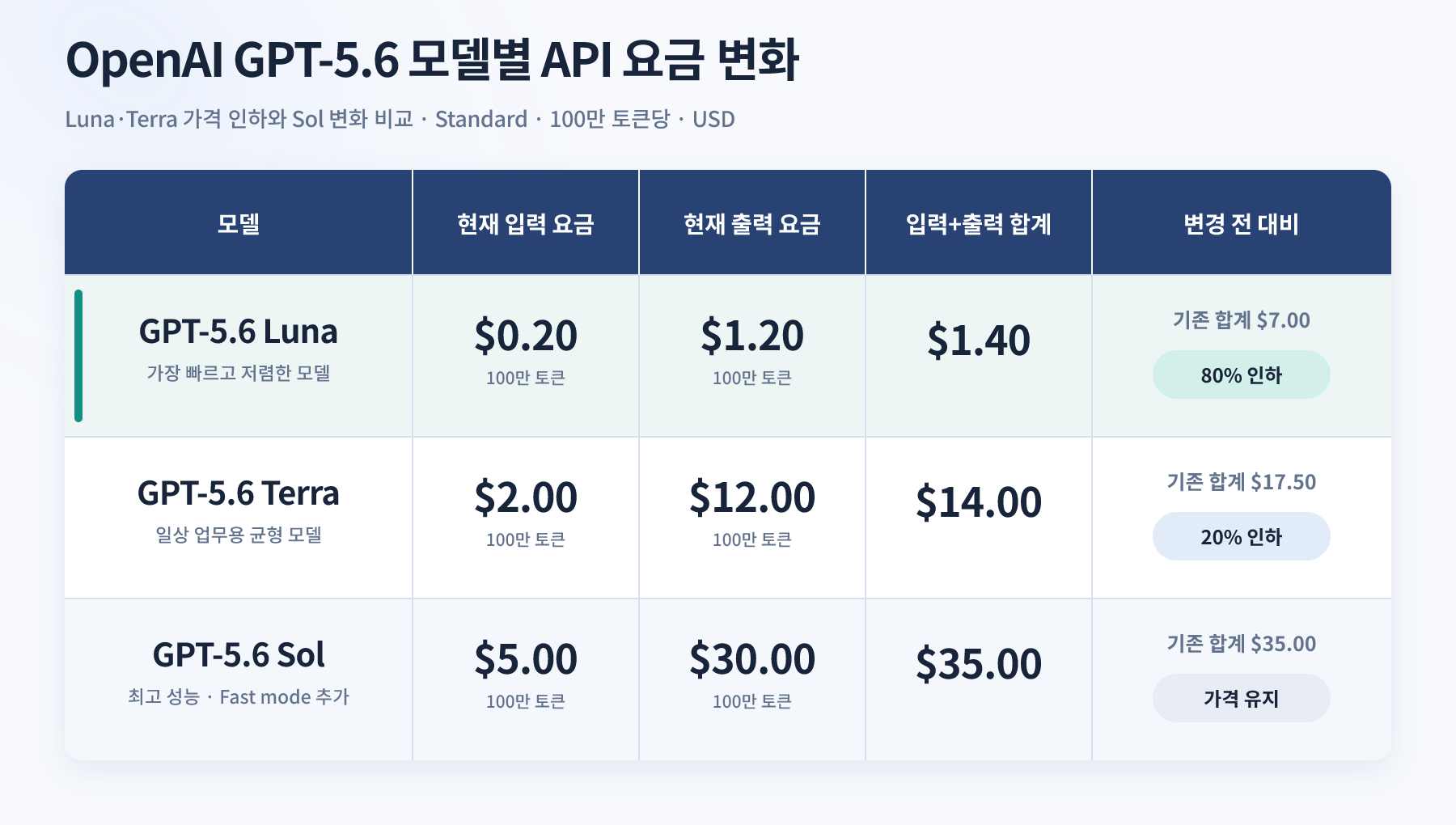
OpenAI is July 30 The price of GPT-5.6 Luna has been reduced by 80%, while the price of Terra has been reduced by 20%; additionally, a "Fast mode" has been introduced for the top-tier Sol model, which increases API response speed by up to 2.5 times.I did.
Although the model itself isn’t a new release, this effectively means that both cost and speed—the factors most noticeably impacted when applying AI to actual services—have changed simultaneously. Especially for AI agents that handle large volumes of repetitive tasks or for coding automation, this price adjustment could represent a bigger change than a few points in performance scores.
So, exactly how much have the prices of the three models changed, and what impact will this have on regular users of ChatGPT and Codex?
| Three Changes in This Announcement
The key points of this update can be summarized in three ways.
First, the fastest and most affordable The API pricing for GPT-5.6 Luna is 80% lower than before It went down. Striking a balance between performance and cost Terra is also down 20% It's become more affordable, and, The base price of the Sol, the top-of-the-line model, remains unchangedOkay.
However, in Sol, Fast mode has been addedOkay. While maintaining the same level of intelligence, compared to the standard process... Up to 2.5 times faster It's an option that lets you get results. Instead of increasing the speed, The price is set at twice that of standard processingOkay.
There are some points we need to distinguish here as well. The monthly subscription fees or total usage limits for ChatGPT and Codex haven't increased. It's more like a change where the number of credits deducted for the same actions when using Terra and Luna has decreased.
In other words, for general users, this means they can use the more affordable model for a longer period of time, while for API developers, it means the actual token costs they’re charged have immediately decreased.
| What Makes Sol·Terra·Luna Different?
GPT-5.6 isn't a single model; it consists of three tiers: Sol, Terra, and Luna.

Sol is the top-tier model designed for complex specialized tasks and work that requires a high level of judgment, such as coding and research. Terra is a model that strikes a balance between performance and cost for everyday knowledge-based tasks, while Luna is the fastest and most affordable model, designed for tasks involving frequent requests or high throughput.
If we draw a parallel with the names of the previous GPT series, Sol can be seen as the standard flagship model, Terra as the “mini,” and Luna as the “nano.” Rather than simply categorizing the three models as “good,” “average,” or “bad,” Choose based on the difficulty and cost of the jobIt's a structure where roles are divided so that people can do their jobs.
All three models support a context window of up to 1.05 million tokens and a maximum output of 128,000 tokens.Yeah. Just because it's a small model doesn't mean you can't feed it long data, but there may be differences in its ability to read and interpret the same data, as well as in the computational cost.
Ultimately, the important question is not “What is the strongest model?” but rather “What is the most suitable model for this task?”It's getting closer.
| Luna 80% Inha Has Lowered the Barrier to Entry for Large-Scale Projects
The biggest change is LunaIt appeared there.

Before the price reduction, it was $1 per 1 million input tokens and $6 per output token. Starting July 30, Input: $0.20, Output: $1.20It went down to that level. The cost of repeatedly fetching cached data is $0.02 per million tokens.
For example, let's assume that 10 million tokens are used as input and 1 million tokens as output over the course of a month. At the previous price, it would cost a total of $16, but at the new price, it's $3.20....decreases. For services where usage reaches hundreds of millions of tokens, the difference becomes much greater.
This is exactly the kind of high-volume processing task Luna is designed for. It’s well-suited for tasks like classifying inquiries, summarizing short documents, extracting information in a specific format, writing and testing repetitive code, and acting as a background agent—tasks where the ability to quickly complete a large number of tasks is more important than peak performance on a single task.
However, just because the price has gone down doesn’t mean it’s the right move to shift all tasks to Luna. For tasks where conditions are ambiguous or the cost of errors is high, you need to compare the actual results to determine whether stronger inference is required. The advantage of this change is that it doesn’t mean unconditionally sacrificing quality; rather, it allows you to significantly reduce the costs associated with simpler steps.
| Terra Cuts Prices by 20%, Targeting the Core of Everyday Work
The price of Terra is From $2.50 to $2 per 1 million input tokens, and from $15 to $12 per output token It's gone down. The cash input is $0.20.

If we process 10 million tokens as input and 1 million tokens as output in the same way, the cost will be From the previous $40 to $32...has been reduced. While it's not as dramatic a reduction as Luna's, for services that use AI consistently every day, even a 20% difference is hard to ignore.
Terra is well-suited for tasks that require both quality and speed, such as answering document-based questions, organizing information, general coding, and conducting research and writing within a certain scope. It serves as a middle ground when calling the most powerful model every time is too resource-intensive, but you still need more reliable decisions than those provided by the smallest model.
In particular, it could become more useful in services that combine multiple models rather than having a single AI handle every step. This is because it’s possible to leave most routine tasks to Terra and only hand them off to Sol when complex decisions are needed.
| Sol prioritized speed over price
The standard API price for Sol, the top-tier model, is $5 per 1 million input tokens and $30 per output token, MaintenanceOkay.
However, if you use the newly introduced Fast mode, you can get responses up to 2.5 times faster than with standard processing without changing the model's intelligence level. Previously, The renaming of "Priority Processing" to "Fast mode"And requests that were previously set to "priority" will continue to work as usual.
The price of Fast Mode is twice that of standard processing.Hey. So there’s not much reason to use it for simple batch jobs or analyses that can run overnight. It really comes into its own when a few seconds can directly impact the service experience or business outcomes—such as coding tools that users are waiting for, near-real-time business support, or handling important customer inquiries.
It's also important to look closely at the speed claims. There's no guarantee that every request will always be 2.5 times faster; rather, for supported Sol operations, Up to 2.5 times fasterIt means that it provides [...].
There is also a limitation in that long contexts, fine-tuned models, and embeddings do not support Fast mode.
| How did they manage to lower the price this much?
OpenAI didn't just reduce margins; it connected models, inference systems, and tools Improving the agent structure togetherHe explained that it is now possible to handle more tasks with the same amount of computational power.
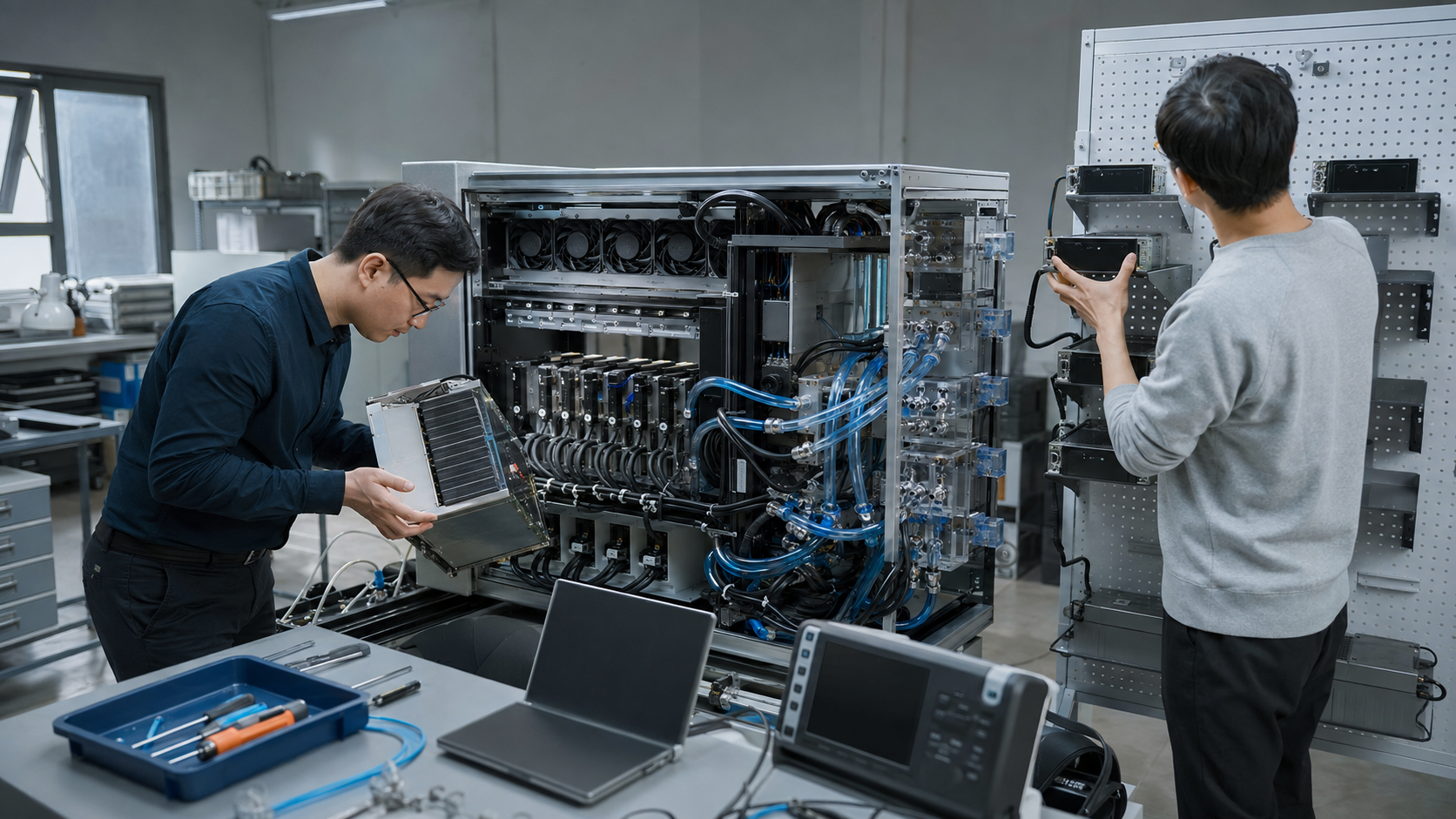
What's interesting is that GPT-5.6 Sol was also used in this efficiency improvement process. Within the human-led development process, Sol served as the core computational code necessary for token generation, Rewrite the production kernelAs a result of this optimization, the model is now deployed to production Helps reduce total costs by 20%They say he gave it to him.
They also said they designed and ran hundreds of experiments, which increased token generation efficiency by more than 15%. The model completes its tasks using fewer tokens, and Allocate hardware resources continuouslyand, Improve the code to avoid unnecessarily repeating context that has already been processedIn a sense, that result led to a price reduction.
However, it would be an overstatement to interpret this as meaning that the AI created the next model entirely on its own, without human involvement. The official explanation also states that Sol assisted with optimization and experimentation within a human-led process. The key point is that AI is beginning to be used not just as a tool for producing results, but also as a development tool for improving the efficiency of the AI system itself.
| What Will Change for ChatGPT and Codex Users?
For people who don't use the API directly, token prices in dollars might seem a bit out of reach.

This adjustment does not change the subscription prices for ChatGPT and Codex or the total credit budget. Instead, When using Terra and Luna in ChatGPT Work and Codex, the number of credits deducted for the same amount of work is reduced. If you focus on using the more affordable models, you'll be able to handle more tasks within your existing subscription.
Based on the current ChatGPT Work and Codex offerings, Free and Go users can use Terra, while Plus, Pro, Business, and Enterprise users can choose between Sol, Terra, and Luna depending on their work needs.
If you've always relied on Sol for simple edits or repetitive tasks, switching to Luna or Terra could help you save on credits. On the other hand, for stages where the quality of the final result is critical—such as complex planning and final reviews—using Sol may be more efficient.
Ultimately, this price reduction is less about an immediate decrease in the monthly fee and more about, A shift toward an increasing volume of AI tasks that can be handled with a single subscription and budgetIt's more accurate to see it that way.
| “Cost per task” is now more important than “top performance”
In the future, it is increasingly likely that simply looking at the top-ranked AI model in benchmarks will become less important.

Sol is ideal for tasks where the cost of failure is high—such as complex problems with only one correct answer, lengthy research and design, and high-level coding. Terra can be a well-rounded choice for document creation, data organization, and general task automation, while Luna is advantageous for tasks where scale matters, such as classification, extraction, and repetitive execution.
There’s also a way to divide the work among models within a single task. For example, Sol analyzes the requirements and draws up a plan, then Luna handles the well-defined implementation and testing in iterations, and finally, Sol reviews the final results. OpenAI also suggests this step-by-step combination of models as a cost-effective approach.
There are also some things to keep in mind when calculating costs based solely on the price list. For long requests with inputs exceeding 272,000 tokens, a long-context fee of twice the input and 1.5 times the output is applied to the entire request, and Fast mode costs twice the standard fee. Actual costs may vary depending on the ratio of inputs to outputs, cache utilization, and the number of tool calls.
The significance of this change lies not simply in the fact that “cheaper AI has emerged.” Rather, it marks the full-scale dawn of an era in which we are moving away from relying on a single high-performance model to handle everything, and instead deploying multiple models based on the difficulty and speed of the task.
Luna’s 80% reduction lowers the barrier to entry for large-scale AI services, while Terra’s 20% reduction cuts the cost of everyday AI tasks. With the addition of Sol’s Fast mode, developers and users can now make more precise choices about which factor—performance, cost, or speed—is most important to them.
As the AI ecosystem continues to accelerate!
I believe it has become increasingly important to stay up to date with the latest information. Going forward, I will do my best to process this information quickly and present it in a way that’s easy for you to understand. Thank you as always!!

References
#OpenAI #GPT56 #GPT56Sol #GPT56Terra #GPT56Luna #ChatGPT #Codex #Generative AI #Artificial Intelligence #AI Model #AI Agent #API #FastMode #AI Development #IT News