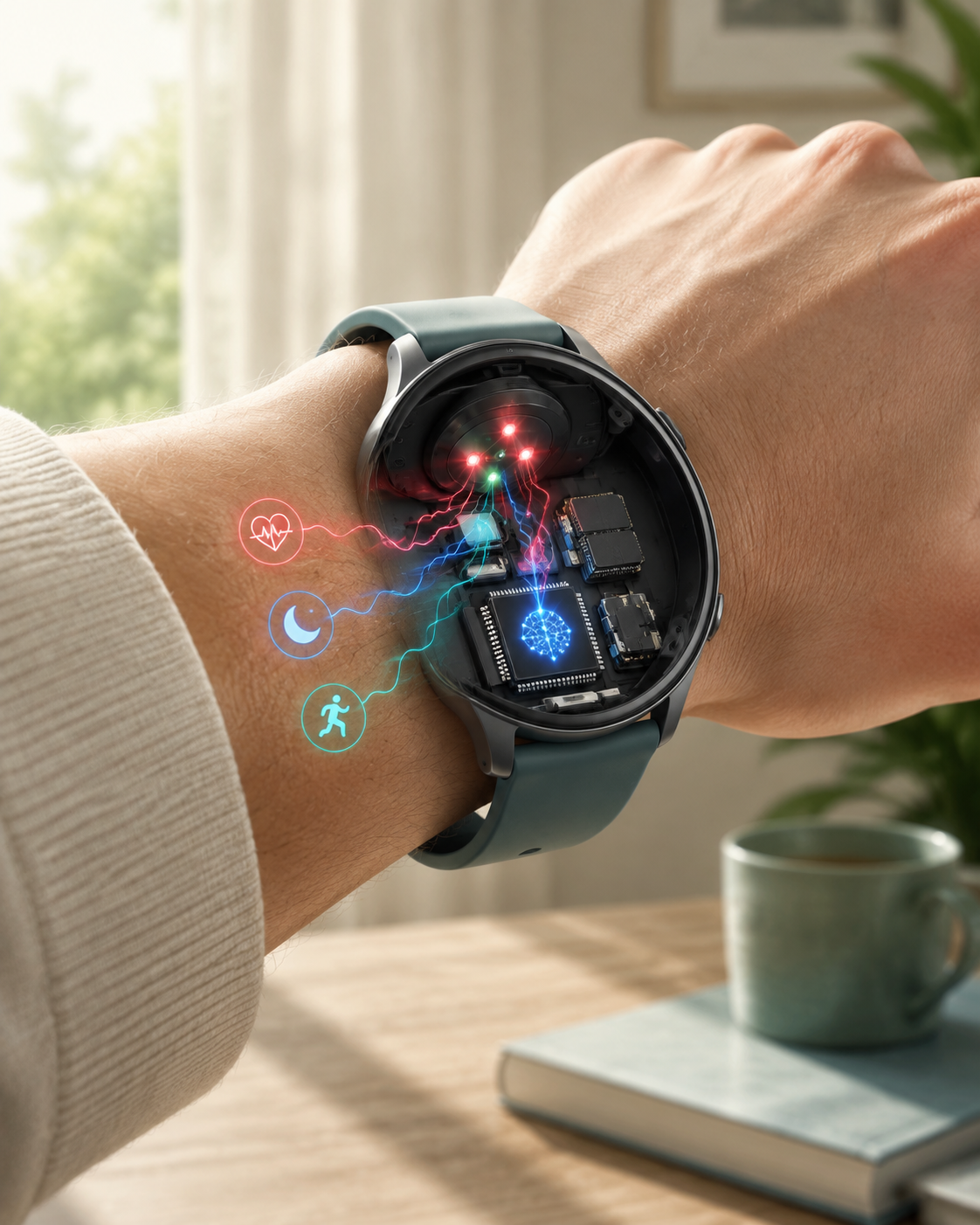
Is a cloud server absolutely necessary for AI to analyze heart rate and sleep data measured by a smartwatch?
According to research released by Samsung Electronics, some analyses will be performed on wrist-worn devices in the future Handle it yourselfShow that it's possible.
On August 14, 2026, Samsung Electronics’ Global Newsroom reported on a health foundation model developed by the Digital Health Research Team at Samsung Research America xMAEWow HiMAEI introduced it.
xMAE learns the temporal relationship between the electrocardiogram (ECG) and photoplethysmography (PPG), while HiMAE hierarchically analyzes wearable data—such as heart rate, sleep, and activity—where meaning emerges across different time scales.
In particular, HiMAE, running on a smartwatch-class CPU, Less than 1 millisecondIt produced the results. This is a noteworthy study because it shows that the concept of foundation models—which used to run in massive data centers—is now being scaled down to fit inside a smartwatch.
| Health Foundation Model
General-purpose health AI is often trained for specific purposes, such as classifying arrhythmias, predicting sleep stages, and analyzing activity levels. To add new features, you have to label separate data sets and rebuild the model.
Health foundation models first learn common patterns from large-scale biosignals and then apply that knowledge to various health-related tasks. The approach of creating a single base model and adapting it for different tasks is similar to that of foundation models in the fields of language and imagery.
The key point here is Self-directed learningWow. The researchers mask part of the biological signals and have the model restore the original data. Even if there aren't enough answer keys, students should learn to identify patterns on their own—such as the repetition of heartbeats, changes during sleep, and differences in signals based on activity— I'm making it.
Although the two models deal with the same wearable data, the problems they aim to solve are different.
|
Model |
Relationships Focused on Learning |
Key Approach |
Role We're Looking Forward To |
|
xMAE |
Temporal Correlation Between ECG and PPG |
Filtered using PPG and some ECG data Restore the ECG |
Learning More Useful Cardiovascular Features from PPG, Which Is Easy to Measure Continuously |
|
HiMAE |
The Relationship Between Short Signals and Long-Term Lifestyle Patterns |
Several encoders with different durations Analyze the data |
Appropriate for each task, such as heart rate, sleep, and activity Select a time unit |
According to Samsung, the xMAE study was accepted by ICML, and the HiMAE study was accepted by ICLR. It’s important to note that these are academic research findings, not announcements of consumer-facing features.
| xMAE
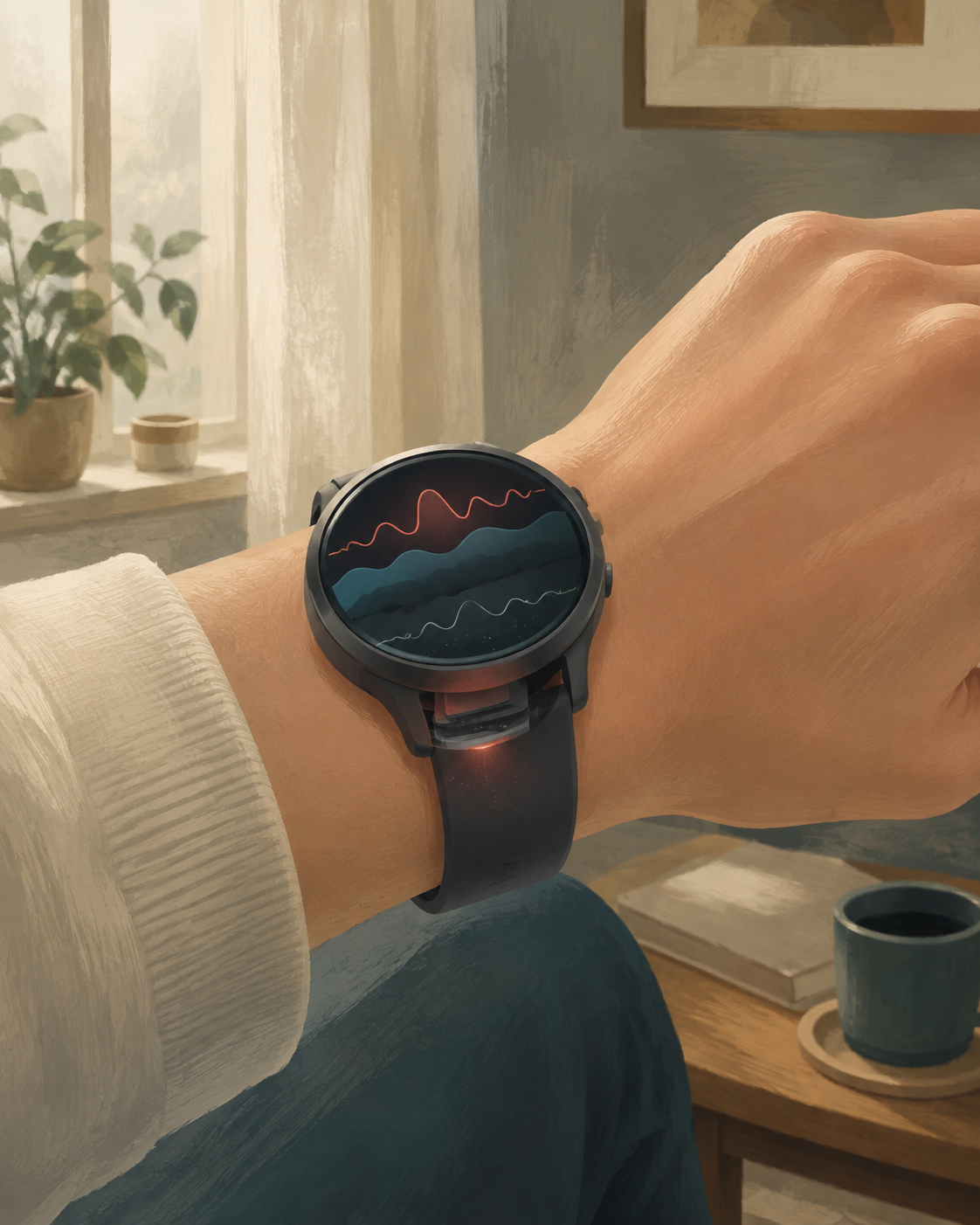
Although both ECG and PPG are signals related to cardiac activity, they differ in what they measure and how they measure it.
An ECG directly measures the electrical activity that occurs when the heart begins to beat. While smartwatches can also provide relatively accurate information, users typically have to place their finger on the electrode and pause for a moment to take a reading.
PPG works by shining light on the skin on the wrist and detecting changes in blood flow. Since it can take measurements for a relatively long time without requiring any action from the user, it is widely used for continuous heart rate monitoring in smartwatches.
Since the electrical impulse in the heart occurs first and the resulting blood pulse reaches the wrist later, there is a time lag between the two signals. It’s similar to how you see lightning first and hear thunder later.
xMAE is trained to mask large portions of the ECG during the learning process and then use the PPG and the limited remaining ECG information to reconstruct the missing parts. It does not simply group signals together based on their similarity, but rather, Designed to learn which signal appears first and how long the subsequent signal lastsI did it.
Here, xMAE is A product that generates a complete ECG using only PPGYou shouldn't understand it that way. ECG reconstruction is a means to an end; the actual goal is to create a base model that better captures the cardiovascular features contained within the PPG.
| Approximately 9,400 hours of study
Samsung says that xMAE is approximately 9,400 hours of paired ECG and PPG data...it was pre-trained, according to the paper. The paper explains that it used approximately 3.4 million 10-second signal segments and data from approximately 2,400 individuals.
It was subsequently applied to 19 evaluation tasks, including the prediction of cardiovascular disease, the detection of abnormal test results, and the classification of sleep stages. Among these, xMAE Across 15 projects It achieved better results than single-biometric models and existing multi-biometric learning methods.
The evaluation utilized approximately 2,300 hours of PPG data and a dataset of 12,500 participants obtained from six studies. It also confirmed the potential to apply the learned features even when sensor devices, measurement locations, and data collection environments vary.
|
xMAE Research Projects |
Disclosed Scale and Results |
|
Pre-training data |
Approximately 9,400 hours of ECG and PPG data |
|
Pre-training Signal Interval |
Approximately 3.4 million 10-second segments |
|
Pre-course participants |
About 2,400 people |
|
Scope of Evaluation |
6 studies, 19 projects |
|
Better results than the comparison model |
15 out of 19 projects |
However, the fact that the model outperformed the comparison model in 15 tasks does not necessarily mean it can accurately diagnose all 15 diseases. Since this result compares representation learning capabilities based on research data and predetermined evaluation conditions, clinical validation and regulatory procedures in actual medical settings are separate steps.
| HiMAE

The information revealed by wearable data varies depending on how long you look at it.
Over very short periods, you can see how your heart rate fluctuates rapidly. If you expand the timeframe to a few minutes or hours, you’ll begin to see slower trends, such as changes caused by exercise, sleep stages, and activity patterns accumulated throughout the day.
If the existing model compresses all data into a single, fixed time unit, the resulting information might be too brief for some tasks and too lengthy for others. In other words, you can’t use the same magnification level when examining a single heartbeat as when analyzing a full night’s sleep.
HiMAE is Analyze short and long segments separately using multiple encodersYes. Each layer of the model generates features across different time scales; it is designed to use fine-grained signals for heart rate analysis and longer-term trends for sleep prediction.
When training, mask part of the wearable signal and then restore it Self-directed learningUse it. Another key feature is that a single pre-trained model can handle not only classification but also numerical prediction and data generation.
| Why Processing Speeds of Less Than 1 Millisecond Matter

Simply analyzing health data well isn't enough to incorporate AI into a smartwatch. This is because wrist-worn devices have less memory and computing power than smartphones or servers, and they're also sensitive to battery life and heat generation.
According to the HiMAE paper, the model is approximately 1.2 million parametersWow 4.8MB It is organized by size. When the research team tested it on a smartwatch-class CPU, the latency per inference was approximately 0.99 millisecondsAnd Samsung showcased this with a processing speed of less than 1 millisecond.
This is a design approach that is completely different from that of large language models, which use hundreds of millions of parameters. For wearables, a small, specialized model that can quickly interpret the temporal structure of biosignals within limited resources is more suitable than a massive model containing all knowledge.
Furthermore, HiMAE goes beyond simply transferring the model to a smartphone for computation; it processes the data directly on the smartwatch itself, where the signals are collected. OnWatch AI It demonstrated the potential. This lays the groundwork for performing real-time analysis within the device without having to wait for a connection or server response times.
However, 0.99 milliseconds refers to the model inference time measured under the hardware, input, and deployment conditions specified by the research team; it does not mean that the entire process—from sensor measurement to on-screen notification—is completed in 1 millisecond. In actual products, Sensor quality, preprocessing, operating system, battery usageWe need to verify that as well.
| Benefits of On-Device Processing
Currently, many AI services send data collected on devices to servers and then receive the results calculated by the servers. While this approach is advantageous for running complex models, it requires an internet connection and involves transmission latency, and sensitive data may be transferred outside the device.
Health data is more sensitive than general content logs because it contains information about a user's lifestyle and physical condition. If analysis can be completed within the smartwatch, it is more likely that the frequency and scope of sending raw biosignals to the cloud will be reduced.
|
Category |
Cloud-Centric Analytics |
On-device analytics |
|
Location of Operations |
Remote Data Center |
Inside a Smartwatch |
|
Connection Dependency |
A network is required for data transmission |
Some tasks can be completed without an internet connection |
|
Response Delay |
Subject to transmission time and server status |
Can be processed directly on the device |
|
Raw Data Transfer |
Server transmission may be required |
Can be left inside the device |
|
Equipment Costs |
Relatively low |
Optimization of processing power, memory, and battery life is required |
However, just because something is “on-device” doesn’t automatically guarantee privacy. This is because information can still be transferred outside the device depending on whether analysis results are synchronized, app permissions, backup methods, and data retention periods.
If the product is released, key evaluation criteria will include what data remains on the device and what is transmitted to a smartphone or server, as well as whether users can directly control this.
| From Sensor Diversity to Analytical Models

The competition in the smartwatch market has so far focused on incorporating more sensors and expanding the range of metrics. However, even if data accumulates from these sensors, its practical applications are limited unless it can be transformed into information that users can understand.
xMAE and HiMAE aren't simply studies that add a single new sensor. Rather, they are attempts to gain a deeper understanding of the relationships and temporal structures among signals already obtainable from wearables, with the goal of identifying more useful features from the same data.
At the Health Forum during Galaxy Unpacked in July 2026, Samsung will shift from a reactive approach—treating conditions after they arise—to a preventive, personalized, and connected approach to healthcare. Connected Care He presented a vision. The health foundation model could serve as the underlying technology that interprets data from various sensors and devices as a single stream.
From a strategic perspective, it is highly likely that the factors that set smartwatches apart will not be determined solely by the number of sensors or screen size. How quickly and reliably the model runs on limited hardware, and how it provides meaningful insights while minimizing the amount of user data that needs to be transferredThat's what becomes important.
This trend doesn't mean that data center-centric AI competition is coming to an end. The process of training foundational models using large-scale data still takes place on servers, while the trained, smaller models handle inference on smartwatches. Cloud Learning and On-Device Inference It's highly likely that the structure will evolve alongside it.
| Still part of the research
There are reasons why it's too early to conclude that this announcement is about features for the upcoming Galaxy Watch.
The HiMAE paper describes the results obtained on a smartwatch as those of a research prototype and clarifies that the technology has not been deployed in commercial products.
Samsung has not disclosed the timing of the actual implementation of xMAE and HiMAE in products, the supported devices, or battery consumption.
Achieving high performance in research evaluations and obtaining approval for medical functions that diagnose the health status of actual users are two distinct stages.
It is necessary to validate differences arising in real-world environments—such as skin characteristics, wear location, movement, and sensor contact status—across various groups and over an extended period.
Since the potential for on-device processing does not necessarily correspond to the actual level of data protection, it is necessary to review the product’s policies regarding synchronization, storage, and user consent.
Therefore, the significance of this study does not lie in the idea that smartwatches will soon replace doctors. In demonstrating the technical feasibility of running biosignal-based models—which until now had been easy to process on servers—even on the limited hardware available on a wrist.
Four Things to Check Going Forward
First, it remains to be seen whether xMAE and HiMAE will actually be implemented in the Galaxy Watch and Samsung Health features. There is still a need for optimization, quality verification, and user experience design between the research announcement and product integration.
Second, we need to determine whether performance is maintained across different ages, skin types, living environments, and device usage habits. A foundation model can only prove its versatility if it operates reliably even for users outside the scope of the research data.
Third is power consumption and heat generation during continuous operation. Even if the instantaneous inference speed is fast, the battery life shouldn't decrease significantly when reading and analyzing sensor data all day long—that's what makes it practical for real-world use.
Fourth, users need to be able to clearly understand where their data is processed and stored. The competitiveness of health AI should be evaluated not only based on accuracy but also on the extent to which data is processed within the device, as well as features related to consent and deletion.
The recently unveiled xMAE and HiMAE are Compensating for the weaknesses of wearable AI in different waysxMAE learns the relationship between ECG and PPG to enhance the utility of continuous measurement signals, while HiMAE analyzes health patterns across multiple time units using a small model, opening up the possibility of running it on a smartwatch.
The center of gravity in the AI industry is no longer confined to data centers but is shifting closer to smartphones, PCs, and now smartwatches. Samsung’s latest research suggests that the next battleground for on-device AI will extend beyond photo editing and translation to How quickly and safely sensitive biological signals can be interpretedIt's a sign that it could expand.
Thank you for reading!

References
#Samsung Electronics #SamsungResearch #HealthAI #Foundation Model #xMAE #HiMAE #Smartwatch #On-Device AI #Wearables #SamsungHealth