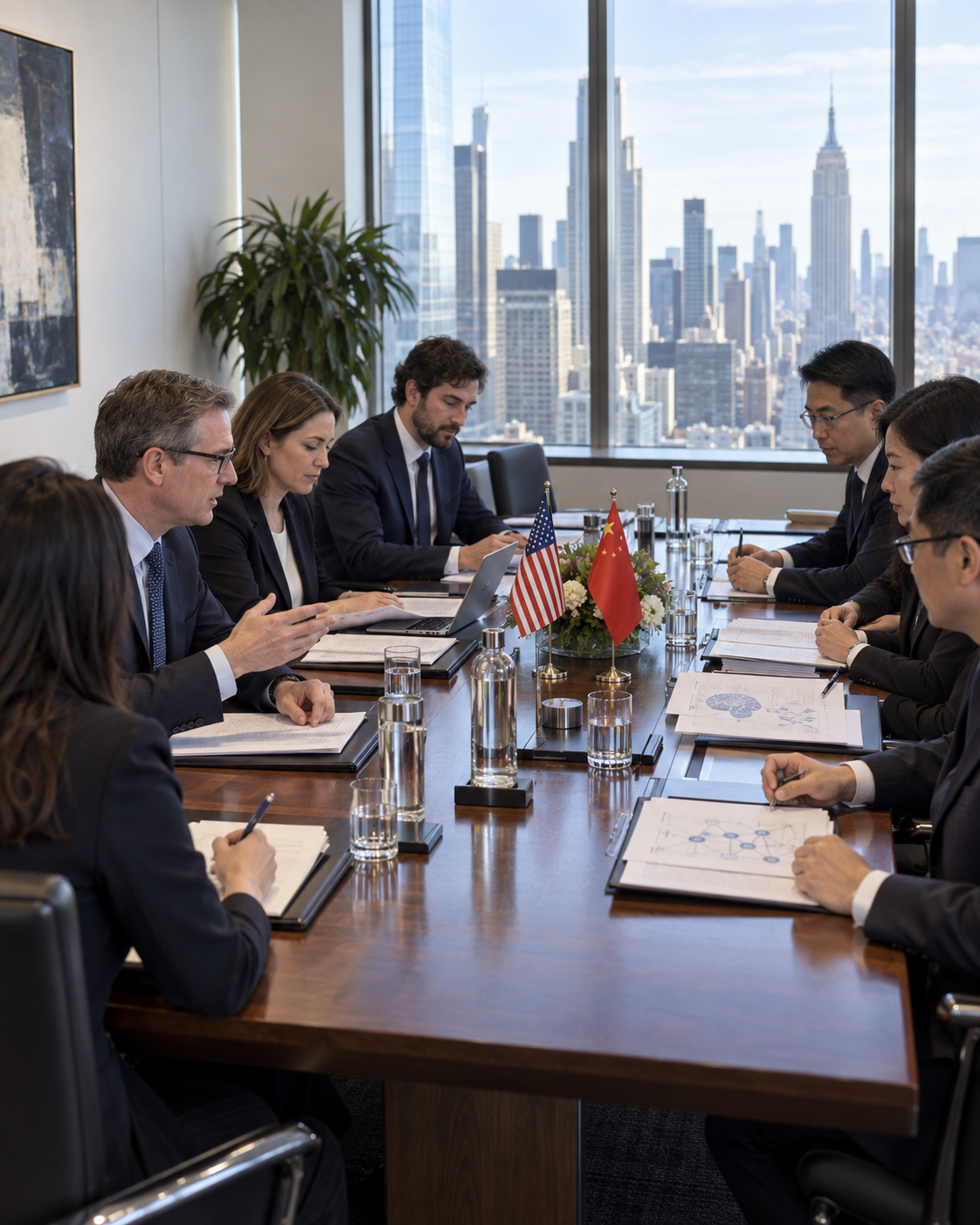
The United States and China have agreed to formally include artificial intelligence guardrails on the agenda for their high-level economic and trade talks. Reuters reported that U.S. Treasury Secretary Scott Bessent and Chinese Vice Premier He Lifeng are scheduled to meet in New York on September 20, 2026, to discuss AI, tariffs, and critical minerals.
In the field of AI, The risks associated with open-source and closed-source models, as well as measures to prevent powerful models from falling into the hands of malicious non-state actors, were presented as key agenda items. However, at the time of the report, the meeting had not yet taken place, and no common standards or joint statement had been finalized.
Therefore, this news is significant in that the U.S. and China have elevated AI risks to a high-level bilateral agenda item. It is still too early to interpret this as an agreement in which the specific details of the guardrails and the verification methods have been finalized.
| One of the items on the agenda for the New York talks is AI.
U.S. Trade Representative Jamison Greer is also scheduled to participate in the meeting between Minister Besant and Vice Premier Heo. The meeting is scheduled to begin at 10:30 a.m. local time—around 11:30 p.m. on September 20, Korean time—at the JPMorgan Chase headquarters in Manhattan, New York, and is expected to last for one day.
In addition to AI, the U.S.-China trade truce—set to expire on November 10—as well as the supply of Chinese rare-earth magnets and critical minerals, tariffs, and investment issues are all expected to be discussed. These talks are largely intended to coordinate potential agreements ahead of the scheduled summit between Trump and Xi Jinping.
China's Ministry of Commerce announced that Vice Premier He will lead a delegation of Chinese business representatives on a visit to the United States to participate in economic and trade consultations. However, the specific conditions that China is willing to accept regarding AI guardrails have not been disclosed.
| Covering both open-weight and closed-loop models

An open-weight model is an AI that allows users to download the trained core weights and either run them directly or adjust them to suit their needs. Closed models, on the other hand, often do not disclose their weights, and providers typically offer their functionality via the web or through an API.
While open-source software has advantages in terms of cost, accessibility, and research applications, it presents the challenge that developers find it difficult to control how it is used once it has been deployed. Closed models restrict access at the central level and make it easy to update security measures, but they have been criticized for concentrating power in the hands of a few companies and making it difficult to verify their internal operations from the outside.
Secretary Besant stated that the scope of the discussion would include both types. Rather than an approach that bans a specific disclosure method, This can be interpreted as an agenda aimed at finding a common safety standard that balances the model's capabilities with the risks associated with its use.
| The goal is to block access by malicious non-state actors.

The key objective of the guardrails proposed by the U.S. is to reduce the risk of powerful AI models falling into the hands of malicious non-state actors. Here, “non-state actors” refers to entities that operate outside of state control, such as criminal organizations or independent attack groups, as opposed to governments.
However, it has not been disclosed what level of model would be considered powerful, which of the following—downloads, cloud access, or chip exports—would be subject to controls, or how compliance by the other party would be verified. The term "guardrail" alone doesn't reveal the strictness of the rule or how it's enforced.
To reduce common risks, the two countries must, at the very least, We need to standardize the terminology first—from model performance evaluation to incident reporting and access control. If this step is omitted and only declarative principles are agreed upon, the actual impact may be limited.
| Cooperation and technological competition operate simultaneously,

The United States and China are the two countries leading the way in cutting-edge AI models and the semiconductor ecosystem. U.S. companies have a strong presence in closed-source, top-tier models, while China’s open-source models are attracting interest from U.S. companies due to their relatively low cost and customizability.
In this structure, It is difficult to separate safety considerations from industrial competition. If the U.S. tightens risk controls, it could affect the overseas distribution of the Chinese model and access to semiconductors, and China is likely to view this as an attempt to curb its technological advancement.
Minister Besant stated that she is open to discussions aimed at avoiding common risks and preventing a complete divergence between the two countries’ AI systems. However, given the ongoing disputes over export controls and national security, it remains uncertain just how far the scope of cooperation will extend.
| No agreement has been reached yet, nor has a joint body been established.

As of the time of this report, the two sides had not yet concluded their AI negotiations but were preparing for a meeting. None of the following have been finalized and made public: the joint statement, the working group, the risk assessment criteria, or the implementation schedule.
Tariffs and critical minerals—other key agenda items for the summit—could also overshadow discussions on AI. Given that this is a preparatory meeting for the summit, the focus may be on sending a political signal to continue the dialogue rather than establishing strict rules right away.
So "The start of official consultations" should be understood to mean that AI has been included on the agenda for high-level talks. This doesn't mean the two countries have launched a separate AI agreement or regulatory framework.
| We need to review the documents and follow-up channels after the talks.

This move is This is significant because AI risk management has moved from a peripheral issue to a key agenda item in U.S.-China economic security negotiations. The fact that they mentioned both open-weight and closed models is a sign that they don't view risk as limited to just one distribution method.
The next thing to check is what happens after the talks Whether AI is actually included in the joint announcement, whether a channel for practical consultations will be established, and whether the scope of the guardrails and the verification methods will be specified. It is also important that the two leaders reaffirm the same principles at the summit.
The only things that have been finalized so far are the schedule for the talks and the agenda proposed by the U.S. side. Until a specific agreement is reached, it is more accurate not to assume that the two countries have agreed on AI regulations.
References
Tags
#U.S.-China Relations #AI Guardrail #Artificial Intelligence Policy #OpenWeight #Closed-Loop AI #AI Safety #ScottBessent #Hweori-pung #US-China Summit #Technology Security #AI Governance #Industrial Policy