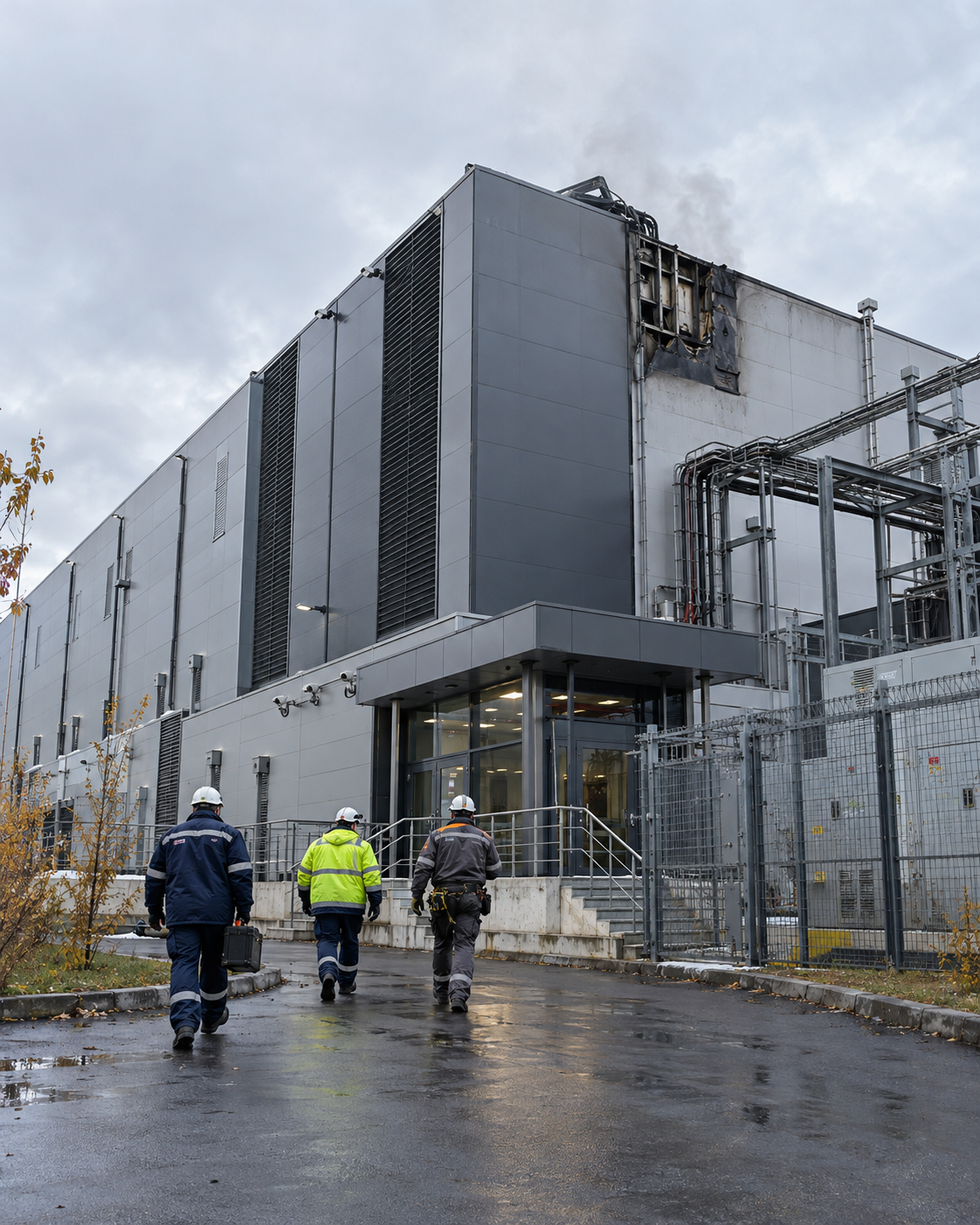
If search, maps, taxi hailing, payments, and even artificial intelligence are all deeply integrated into a single corporate infrastructure, how significant would the impact be if just one data center went down? This question became a very real concern when Russian tech company Yandex suffered drone attacks on three of its data centers within a few days.
On October 11, Yandex confirmed that operations at its data center in the Vladimir region had been completely suspended due to damage to the facility’s infrastructure. Previously, the Sasovo facility had completely ceased operations, and some infrastructure at the Kaluga facility had become inoperable. The company stated that there were no casualties as a result of the attack on the Vladimir facility.
This news isn't just about one more affected facility. Several of Yandex's consumer services were not functioning properly, and Yandex Pay users experienced issues when checking their balances, making payments, and sending money.
| It has been confirmed that the third data center has ceased operations.

On October 11 at 7:16 a.m. Moscow time, the Russian news agency Interfax reported a complete shutdown of the Vladimir data center. That was 1:16 p.m. on the same day in Korea. An announcement regarding the data center posted on Yandex’s official website also included details about the attack on the Vladimir facility and the service outage in an update on October 11.
Yandex explained that relevant experts and response agencies are on-site handling the damage. However, it did not disclose what equipment was damaged, the extent of the damage, the exact amount of computing capacity lost, or when the facility would be back online. Therefore, there is no basis for concluding that the entire data center has been permanently destroyed or that data on specific servers has been lost.
The clear change is that cases have now been confirmed at facilities in three different regions.
| A Series of Incidents Beginning in Sasobo and Kaluga

The first incident occurred on the night of October 7–8 at the Sasovo data center. According to an official statement from Yandex, the facility was severely damaged by a drone attack, resulting in a complete shutdown of operations. Subsequently, on October 9, the Kaluga data center was also attacked, causing some of its infrastructure to fail.
After that, on October 11, the Vladimir data center also went offline, bringing the total number of affected locations to three. The important thing to note here is that operations at all three locations haven't been completely suspended. It would be more accurate to classify Sasobo and Vladimir as "out of service" and Kaluga as "partially disrupted."
In an announcement on October 9, Yandex stated that no employees had been harmed and explained that it was difficult to provide a timeline for recovery. In an update on the 11th, the company also confirmed that there were no casualties in Vladimir.
| Search, Maps, Taxi, and Alisa are being restored in phases

The outage wasn't limited to the server room. According to a statement from Yandex reported by Interfax on the afternoon of October 11, the company was gradually restoring access to its main services, including the AI assistant Alisa, search, Yandex Maps, taxi services, and email. However, some features remained unavailable at that time.
This means there's a difference between being able to launch the service and having all features fully operational. In fact, it is difficult to determine exactly how long a particular feature has been suspended based solely on publicly available data.
Yandex explained that it prioritizes restoring services with the most users. While this prioritization makes sense during a large-scale outage, it means that features with relatively few users or third-party integrated services may take longer to be restored.
| With Yandex Pay, payment issues and data retention were separate problems

One of the most critical issues involves Yandex Pay. On October 11, Dmitry Pirogov, head of Yandex’s fintech division, acknowledged in an official announcement that many users were unable to check their balances, make purchases, or send money. He also stated that recovery efforts are underway but that it is difficult to specify an exact completion date.
At the same time, the company explained that users' money and account records are safe. According to Yandex’s announcement, multiple copies of account records are stored in different locations, and an integrity check confirmed that no records were lost. This is an explanation of the data retention status as verified by the company; it does not mean that all payment functions have already returned to normal.
This case illustrates why data security and service availability must be considered separately. Even if the data remains, users cannot spend their money if some of the servers, networks, or applications needed to retrieve the data and process payments are not functioning.
| Even multiple availability zones in the cloud aren't a foolproof shield

The data center supports not only Yandex's own services but also the cloud services used by its enterprise customers. The official Yandex Cloud technical documentation describes an Availability Zone as infrastructure segmented to minimize the impact of different types of failures. Customers can deploy their applications across multiple Availability Zones to prepare for failures.
But just because the available space has been divided doesn't mean all risks have disappeared. If multiple facilities sustain damage within a short period of time, the recovery and rescue efforts themselves will face an even greater challenge.
In particular, Even if data has been replicated across availability zones, recovery may take some time if the service isn't configured to switch over automatically.
| What is the extent of the damage caused by the AI supercomputer?

Another reason this attack is significant in the context of AI industry news is the role played by the Sasovo data center. According to Reuters, two of the three supercomputers used by Yandex to develop its AI models were located at the Sasovo facility. Since training large-scale AI models requires enormous computational resources, the disruption at this facility could put a strain on research and development schedules.
That doesn't mean, however, that both supercomputers were destroyed or that training of the AI models has come to a complete halt. Yandex did not disclose details of the damage to specific equipment, and Reuters also reported that it remains unclear to what extent the supercomputer was actually affected. All that has been confirmed is that operations at the facility have been suspended and that assessments of the damage to the equipment are ongoing.
This is because it requires not only high-performance equipment but also power, cooling, high-speed networks, and large-scale data storage infrastructure. Therefore, the key point to watch in the future is not the performance outlook for a specific model, but whether the actual computing resources can be restored or transferred to another facility.
| This has also had repercussions for companies and users outside of Yandex

Yandex isn't just a company that operates its own apps, such as search and maps. An official company statement explains that hundreds of thousands of businesses use its technology to take orders, serve customers, and run their operations. Reuters also reported that disruptions occurred on external websites and services that rely on Yandex's infrastructure following a previous cyberattack.
In this structure, a problem at a single infrastructure provider could spread to other industries. While this may appear to consumers as a simple app glitch, it can lead to operational issues for businesses, such as missed orders, delayed payments, disruptions in customer service, and business interruptions. Since there are no official statistics yet on the exact scale of economic losses or the total number of affected companies, it is not possible to extrapolate these figures.
Another issue is restoring trust. Even if the service reopens, customers will want to know what alternative options are available in case the same risk occurs again.
| Things to Check Before the Recovery Is Complete
The first thing we'll be looking at going forward is the actual progress of the recovery efforts at the three data centers. We need to verify that the status of each facility’s normal operation, available computing capacity, the full restoration of key services—including Yandex Pay—and the results of the customer data integrity checks are all reported separately.
Second is how reliably Yandex Cloud provides the failover and recovery support needed by its customers. Third is whether the AI computing equipment located in Sazovo has been damaged and the status of securing an alternative environment.
The crux of this incident lies in the fact that, in a wartime scenario, the data center was exposed to physical attacks, and that damage across multiple facilities led to disruptions in the continuity of everyday services such as search, mobility, payments, and cloud computing. While it is significant that Yandex confirmed the preservation of account data, this does not resolve the uncertainties regarding recovery time and AI computing capacity. Ultimately, the only question moving forward is how quickly the facilities can be restored. Rather, the evaluation criteria will be based on how well services and data can be kept independent even if the same type of failure occurs repeatedly.
References
Yandex — Official Announcement on Data Center Status and Update on October 11
Yandex — Official Announcement on the Status of Yandex Pay Recovery
Interfax — First to Report on the Suspension of Operations at the Vladimir Data Center
Interfax — Yandex Announces Phased Restoration of Services
Reuters — Drone Attack on Yandex's Vladimir Data Center
Reuters — Reports on the First Attack and AI Supercomputers
Yandex Cloud — Availability Zone Technical Documentation

Tags
#Yandex #Yandex #Data Center #Drone Attack #RussianIT #Cloud Infrastructure #YandexCloud #YandexPay #AI Infrastructure #Supercomputer #Service Outage #Disaster Recovery #Availability Zone #IT News